Wait… Really?
From bananas to Verdi — a lifelong curiosity

Back in fourth grade at Frank McCoppin Elementary School, our class published a miniature newspaper — articles, columns, a comic strip — cranked out on a mimeograph machine in that distinctive ink you can still smell decades later. One kid immediately claimed the column called “Did You Know?” Its purpose was to share whatever strange or fascinating facts had captured attention that month.
I was that kid.
Some instincts don’t fade. They just wait around, accumulating material.
I still have a weakness for the kind of fact that makes you stop mid-sentence and think: Wait… really? My bias runs toward the scientific and the proven — I’m a secular humanist who defaults to the evidence-based view.
Neil deGrasse Tyson put it well: “The good thing about science is that it’s true, whether or not you believe in it.”
Facts, in the scientific sense, aren’t permanent monuments — they get refined when better evidence arrives. But they’re the closest thing we have to solid ground.
And some of them are staggering.
Take the physical world alone. If you removed all the empty space from the atoms in every human being on Earth — all eight billion of us — we’d fit inside a sugar cube. A day on Venus is longer than a year on Venus: it rotates so slowly that it completes a full orbit around the Sun before finishing a single spin. And the human eye, in complete darkness, can detect a single photon — literally the smallest possible unit of light. Under the right conditions, you are a remarkably sensitive instrument.
Then there’s the question of what we’re made of — and who we are. Every few years, your body replaces most of its atoms. In a very real sense, you are not physically the same person you were a decade ago. And yet something continuous persists: memory, personality, the instinct to collect strange facts.
Which brings us to DNA — and here’s where the fun fact becomes something larger. The Human Genome Project, completed in April 2003, confirmed that the three billion base pairs of human DNA are 99.9% identical in every person on Earth (National Human Genome Research Institute, genome.gov). That remaining 0.1% accounts for everything that makes you distinct — your face, your fingerprint, your particular disease susceptibilities. We share roughly 85% of our DNA with mice. About 60% with a banana.
Pause on that for a moment.
Sixty percent with a banana. Which either says something profound about the deep unity of all life on Earth — every living thing running variations on the same ancient code — or something quietly humbling about bananas. Possibly both.
But here’s what the 99.9% means to me, beyond the biology: at the level of our DNA, the differences between any two people on this planet are almost vanishingly small. The things that divide us — language, culture, history, politics — are written in that fractional 0.1%. Everything else is shared. We are, genetically speaking, essentially the same creature, everywhere.
And what does that creature do, in every culture ever recorded? It tells stories. It makes music. It invents drama and ritual and spectacle. Which is my entirely unscientific but deeply felt explanation for why I — a secular humanist with a scientist’s temperament — also love movies. And opera.
My husband likes to remind me that not all movies are fiction. Documentaries count too, and I’ve worked my way through virtually all of Ken Burns’ meticulously researched work — though I’m still making my way through The American Revolution. Burns does something that is essentially scientific: he follows evidence wherever it leads, trusts primary sources, and lets the complexity speak for itself. History, in his hands, is not simplified but excavated.
But narrative films are my comfort food.
Which brings me to last week, when I watched A Night at the Opera (1935) — the first Marx Brothers film made without Zeppo. The Brothers used Verdi’s Il Trovatore as their climactic battleground, sabotaging a performance by swapping in “Take Me Out to the Ballgame” to humiliate a fraud tenor and give the deserving one his big break. Perfect chaos, aimed squarely at operatic pomposity.
It sent me down a rabbit hole.
Il Trovatore turns out to be one of those works that keeps showing up often — especially, for some reason, in 1930s film and comedy. My husband and I had already stumbled across Moonlight Murder (1936), a comfy little B-movie in which a killing is staged at the Hollywood Bowl during a performance of — yes — Il Trovatore. The opera’s melodramatic plot practically doubles as a blueprint for the film: a troubadour, a scheming count, dark secrets, and a body count. Staging it at the Bowl was a masterstroke. The venue was barely fourteen years old in 1936, but already Los Angeles’s most glamorous outdoor amphitheater, packing in tens of thousands of Angelenos on warm California nights. The grandeur of the setting and the grandeur of Verdi made a perfect backdrop for a movie murder.
The opera itself has a remarkable history. Verdi was, by any measure, a one-man opera factory: after the premiere of Nabucco, he wrote sixteen operas in eleven years. Then came his most astonishing sprint — Il Trovatore premiered in Rome in January 1853 to great acclaim, and just six weeks later, La Traviata opened in Venice. He was composing both simultaneously.
Il Trovatore had a chaotic birth, too. Its librettist, Cammarano, died mid-project in 1852, leaving the work unfinished; he had completed Manrico’s third-act aria, “Di quella pira,” just eight days before his death, and a young replacement finished the rest.
As for the opera’s notoriously tangled plot — Caruso once joked that staging it was easy, provided you had the four greatest singers in the world.
One more small delight: Verdi had originally considered naming the opera after its gypsy character, Azucena — not the troubadour of the title. The opera we now know might have been called La Zingara — (“The Gypsy”) or La Vendetta (“The Revenge”),
The Anvil Chorus, or: Verdi Meets Vaudeville
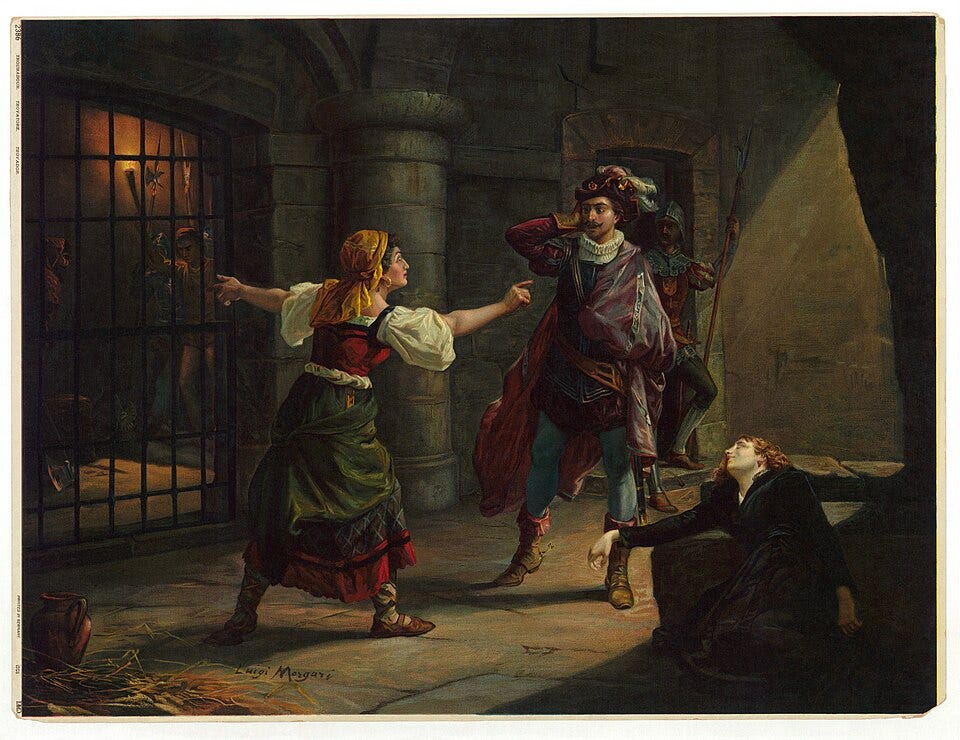
The Anvil Chorus — the rousing “Chorus of the Gypsies” from Il Trovatore, depicting Spanish gypsies hammering their anvils at dawn — is arguably the opera’s most recognizable music. It was also, apparently, irresistible to every comedian working in the 1930s.
None were more smitten than Buster Keaton. In Grand Slam Opera (1936), he plays Elmer Butts, a juggler from Arizona competing on a radio amateur-hour show, and the climax has Keaton getting into escalating scuffles with a bandleader trying to conduct the Chorus during a live broadcast — to the delight of the studio audience. But it was no accident, and no fresh idea. It was old vaudeville muscle memory, a family heirloom dusted off for the screen.
Keaton made his recognized professional first appearance on October 17, 1900, performing fourth in the lineup at Dockstader's Theater in Wilmington, Delaware. More than four decades later, with Hollywood having largely written Keaton off as a relic of the past, a local Wilmington paper looked back on that remarkable entrance into show business:
“Quite the image of his father, Buster, wearing a bald fright wig, chin whiskers, cutaway coat, baggy pants and slapshoes, had hurried across the stage and later, as the orchestra struck up ‘The Anvil Chorus,’ Papa Keaton whacked the youngster with a broom.”
Keaton went on to reprise the Anvil Chorus skit from the Three Keatons’ vaudeville act in Grand Slam Opera. You can watch it right here.
The Marx Brothers were equally devoted to Verdi. In The Cocoanuts (1929), Harpo and Chico play the Anvil Chorus on a hotel’s cash register; in Animal Crackers (1930), Chico plays it on piano while Harpo clangs two horseshoes together.
Verdi, one suspects, might have been horrified. Or perhaps secretly delighted.
As far as we know, Verdi's only operatic frustration -- i.e., the one challenge he could not handle -- involved an operatic setting of Shakespeare's KING LEAR. Verdi worked successfully with MACBETH, OTELLO, and FALSTAFF, but LEAR apparently intimidated him. One can easily understand why...
Delightful presentation of how factual driven life need not forget the the emotional appeal of the arts. Somehow I was reminded of one of the best Bugs Bunny cartoons - The Rabbit of Seville. Opera mixed with silliness.