Pushkin Forward
How Russia’s African Prince Became a Cultural Icon of Russian Literature

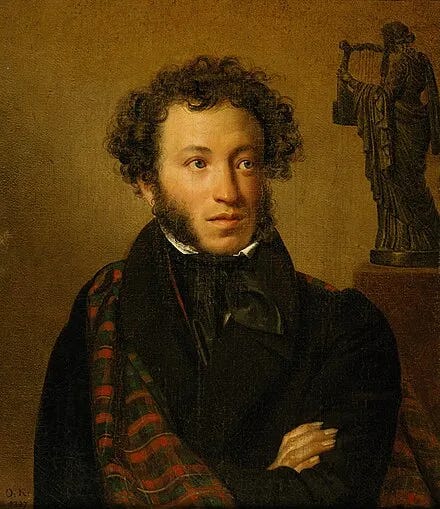
The reverence for Pushkin in Russian culture cannot be overstated. He is considered the foundational figure of modern Russian literature, comparable to Shakespeare in the English tradition. His literary works are required reading throughout the Russian educational system, his statues are erected across numerous Russian cities, and his birthday is commemorated as a cultural celebration. Nearly all Russians can quote pieces of his poems from memory.
The paradox of Pushkin's celebrated status in Russian culture presents a fascinating contradiction. While Russia has a documented history of ethnic discrimination and racial tensions, its most revered literary figure was of mixed ancestry.
Alexander Pushkin (1799–1837) was the great-grandson of Abram Gannibal, a Black African who rose to become a Russian General-in-Chief. Gannibal was kidnapped as a child—likely from the region now known as Cameroon—enslaved, and later presented to Tsar Peter the Great by a Croatian merchant who had purchased him in the Ottoman Empire. Tsar Peter freed Gannibal, then went on to adopt him and raise him in his court household as his godson.
Besides being Russia's preeminent poet, playwright, short-story writer, and novelist of the Romantic era, Pushkin is also a beloved children's author.
As a child of Russian heritage, I encountered magical creatures, wise old men, tricksters, fools, wizards, and sorcerers in his fairy tales. My earliest memory of a Pushkin story was of a golden talking fish in "The Tale of the Fisherman and the Fish." Among other fantastical tales was "Ruslan and Ludmila," with its iconic and magical prologue that reads like an incantation—inviting children and adults alike into a realm where stories breathe and wisdom takes the form of cats and trees (translation):
By the seashore stands a green oak tree;
A golden chain is on that tree:
And day and night, a learned cat
Walks round and round along that path;
When he goes right — he sings a song,
When left — he tells a tale all long.
Pushkin is everywhere in Russia—schools, streets, libraries, and even metro stations bear his name. There's a Pushkin Museum in Moscow and a famous statue in front of the Russian State Museum. His image and legacy are woven into the fabric of national identity, so kids grow up recognizing him almost like a national grandfather figure.
I grew up among Russian émigrés, though I've never been to Russia myself. A century ago my grandparents and many relatives got the hell out of the country during the Bolshevik Revolution, and they never looked back.
Living in the U.S., I've found it striking how differently Pushkin's racial identity is viewed here compared to Russia. In America, racial categories have historically been rigid and binary, shaped by the legacy of the "one-drop rule"—a social and legal principle from the slavery and Jim Crow eras that deemed anyone with any African ancestry as Black. This unscientific standard was a tool of white supremacy, enforcing strict racial boundaries. By that logic, Pushkin—whose African great-grandfather, Abram Gannibal, rose to prominence in Russian society—would be categorized as Black in the U.S.
As a result, in the American context, Pushkin is often celebrated as a "Black genius," a symbol of African diasporic brilliance refracted through America's racial lens and sense of diasporic pride.
Russia, by contrast, never imposed a "one-drop rule." Racial identity there has been more flexible, shaped by factors like class, culture, and language rather than fixed ancestry. Pushkin was a member of the nobility, deeply embedded in Russian aristocratic and literary life, and viewed as ethnically and culturally Russian. His African heritage is recognized—sometimes even romanticized—but it's generally seen as a biographical curiosity, not a defining trait.
Historically in Russia, "whiteness" wasn't a racial identity in the way it has been in the U.S. Instead, "Russianness" was more closely tied to Orthodox Christianity, language, and cultural belonging. Though some of Pushkin's peers described his appearance as "exotic," it didn't keep him from being embraced as fully Russian, or even white.
In the Russian tradition, Pushkin is regarded as white: a nobleman, an Orthodox Christian, a Russian-speaking icon. His African ancestry is acknowledged but typically treated as a fascinating side note, rather than a core element of who he was.
But how did Pushkin perceive himself?
Pushkin didn't describe himself as Black in the modern racial sense, nor African as a primary identity—but he recognized this heritage as essential to his identity and legacy. He was keenly aware of the way his physical appearance—his curly hair and darker complexion—set him apart from many of his peers. He embraced it with poetic flair, ironic wit, and historical imagination. His identity was hybrid: Russian in spirit, African in blood, European in influence, and universal in genius.
Pushkin primarily saw himself as Russian—culturally, linguistically, and patriotically. He considered his life's work to be deeply embedded in shaping Russian literature and national identity. Yet his influences were cosmopolitan: he drew from Shakespeare, Byron, the Enlightenment, and Classical antiquity. His style and voice blended East and West, aristocracy and folklore, which allowed some later critics to call him a kind of "citizen of the world," even if that's not a term he used himself. He was a literary cosmopolitan with deeply rooted national pride.
And Pushkin was undeniably proud of his African roots. Paraphrased from the narrative tone describing Ibrahim, the character based on his great-grandfather, there's this passage from Pushkin's unfinished novel The Moor of Peter the Great (1827): "Proud of his dark skin, the Moor was even prouder of his mind, his knowledge, and his unshakable loyalty."
A letter Pushkin wrote to the Russian poet Pyotr Vyazemsky (1824) captured the essence of Pushkin's self-perception as bridging cultures, climates, and civilizations: "I write for the Russian ear, but my soul has danced with Africa's heat and Europe's cold reason." (paraphrased translation)
It's been decades since I read Pushkin's fairy tales as a child, but as an opera lover, I still run into his influence. Two major Pushkin-based operas were composed by Tchaikovsky: 1) Eugene Onegin (1879), based on Pushkin's verse novel Eugene Onegin (1833); and 2) The Queen of Spades (1890), based on Pushkin's short story The Queen of Spades (1834).
Then there were composer Rimsky-Korsakov's three operas The Golden Cockerel, Mozart and Salieri, The Tale of Tsar Saltan (based on Pushkin's fairy tales of the same names), Modest Mussorgsky's opera Boris Godunov (based on Pushkin's historical drama), and Sergei Rachmaninoff's Aleko (based on Pushkin's poem The Gypsies).
Pushkin’s life was brief, yet his impact reached far—shaping me and countless others across the globe. His legacy lies not only in his writing, but in the way he turned literature into a reflection of the human spirit, grounded in cultural identity, the growth of language, and emotional honesty.
Pushkin played a vital role in ushering in the modern literary age in Russia—his language, style, and bold originality laid the foundation for generations of writers and changed the course of world literature. He didn’t just shape Russian literature—he transformed it, and in doing so, nudged the world forward too.
###
[ii] https://www.blackpast.org/global-african-history/pushkin-aleksandr-sergeyevich-1799-1837/
[iii] https://www.blackpast.org/global-african-history/hannibal-abram-petrovich-gannibal-p-1696-1781/
[iv] https://www.waggish.org/2014/the-black-pushkin-and-the-blackamoor-of-peter-the-great/
[vi] https://en.wikipedia.org/wiki/Category:Operas_based_on_works_by_Aleksandr_Pushkin
[vii] https://www.seattleoperablog.com/2019/12/literature-and-legacy-of-alexander.html
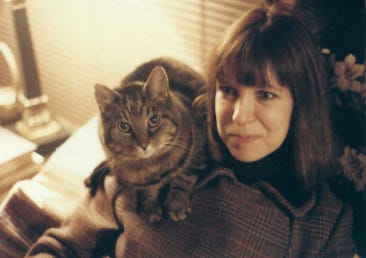
Younger me with Pushkin the Cat, my companion in life and memory.
Fascinating. Thank you for posting