Poppycock
Why Humans Often Prefer a Wrong Answer to No Answer at All

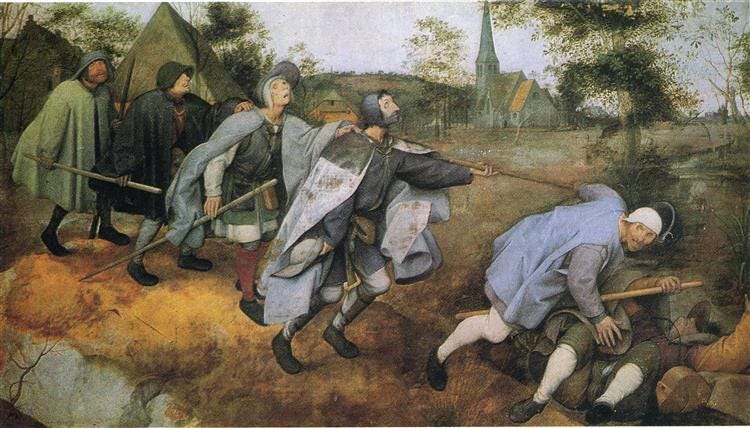
The word itself deserves resurrection. Poppycock began as a Dutch expression for soft dung, then passed through Victorian hands and emerged oddly civilized: a way to call nonsense nonsense without sounding angry about it. The Victorians understood something useful. Most mistaken beliefs are not born from lack of careful thought. They are born from longing, fear, hope, loneliness, grief, or simple habit. Calling them absurd is easy. Understanding why they persist is harder. Humor helps. It secures our entry before objections surface.
Before the list starts, one thing should be said in defense of the people on it. Every example that follows is evidence of something deeply human, not simply something uniquely foolish. We are a species that knows enough to ask terrifying questions and yet, for most of us, not enough to answer them. We know we will die. We do not know why we are here. We are pattern-seeking animals dropped into a universe that doesn’t explain itself. Faced with that uncertainty, we go looking for meaning wherever we can find it. The elf in the boulder, the prophecy in the sacred text, the lucky charm, the horoscope, the sacred undergarment — all are attempts to impose order on mystery.
The problem is not the search. The search is inevitable. The problem begins when comfort is mistaken for evidence, when wanting something to be true becomes indistinguishable from knowing it is true. That is where poppycock enters the story.
Members of the Church of Jesus Christ of Latter-day Saints who have been through the temple wear a garment beneath their clothes — plain, knee-length, unremarkable to anyone else — but understood by believers as a sacred symbol and reminder of religious commitments. The practice has produced its own small ecosystem of modesty-compliant swimwear and the occasional panic among teenagers searching for formal wear that satisfies both contemporary fashion and the church’s expectations about modesty.
In parts of Sicily, villagers still carry a saint’s statue through the streets and watch closely to see which way it leans, treating the tilt as a clue to the coming harvest.
Cricket players from Australia to India cling to rituals no less earnestly: lucky jerseys that cannot be washed during a winning streak, careful routes onto the field. One celebrated fast bowler reportedly wore the same unwashed socks through an entire run of victories. The saint, the garment, and the socks are all variations on the same theme. Somewhere in the machinery of the universe, cause and effect have been joined by hope.
Nor does any of this require leaving the West, joining a religion, or giving up your graduate degree. A substantial number of Americans read their horoscope and let it nudge some small decision. Tarot decks sell briskly to people who insist they do not literally believe the cards, only to speak about them with remarkable seriousness once the cards are on the table. Psychics and palm readers continue to find paying customers in cities that also contain research hospitals and departments of neuroscience.
The faces change, but the business model remains remarkably stable. Victorian séances became auditorium channelers, and auditorium channelers became cable-television mediums speaking to the dead under ring lights.
Meanwhile, homeopathic remedies — diluted beyond the point of containing any meaningful trace of the original substance — have spent decades occupying pharmacy shelves and medicine cabinets. Feng shui has persuaded architects in Hong Kong to leave openings in skyscrapers so dragons may pass unobstructed to the sea, which may be the most charming example on the list, though charm and evidence are not, unfortunately, the same thing.
It is worth pausing for a moment to ask what all of this is actually doing for people.
Nobody reads a horoscope because they’ve carefully evaluated the evidence for planetary influence. They read it because life feels uncertain and a sentence that sounds uncannily personal can be comforting. Nobody visits a medium expecting courtroom standards of proof. They go because grief leaves a space that reason cannot fill. Five more minutes with the supposed voice of someone you loved can be worth almost anything.
While the belief itself is unreasonable, the impulse behind it is not entirely irrational. If anything, it is one of the more recognizable things about being human. Faced with uncertainty, many reach for stories. Faced with silence, many prefer an answer, even a doubtful one. Most humans, it seems, would rather be comforted than left alone with a question that has no reply.
Some of these beliefs remain harmlessly eccentric. Others leave bodies behind them.
In parts of Tanzania, Malawi, and neighboring countries, people with albinism have been attacked and killed because their body parts are believed to carry magical powers that bring wealth or political success. The victims are often children. Elsewhere, accusations of witchcraft continue to lead to beatings and killings. The “evidence” offered is usually no stronger than the evidence behind a lucky charm or a horoscope. The difference is that one ends in a punchline and the other ends in a body.
The anti-vaccine movement belongs in this category as well. Its modern form traces much of its energy to a fraudulent study that crumbled under scrutiny decades ago. The study disappeared. The belief did not. That persistence ought to retire the comforting idea that credulity is mainly a problem of poverty or lack of education. Human beings do not stop being human when they earn a degree.
And here is where the list gets honest, because one entry on it has spent two thousand years insisting it isn’t actually on the list. Christianity, practiced today by roughly a third of the people on Earth, claims a category entirely its own — not merely unproven like everything above it, but sacred, and therefore often treated as exempt from the evidentiary demands we make of other extraordinary claims. Few beliefs in human history have enjoyed that degree of cultural and institutional protection. Nobody has ever built a continent’s legal system around lucky socks. Nobody has ever burned a person alive for doubting feng shui.
The mechanism underneath Christianity is identical to every entry above it — a belief absorbed before it could be examined, defended past the point evidence would justify, organizing votes and marriages and the raising of children the way a horoscope organizes a Tuesday — but it has had two thousand years and an empire to dress the mechanism up as something other than what it is. The larger and older a claim is, the more rigorously we should examine it. Yet familiarity and cultural prestige often cause people to lower their evidentiary standards. Scale has granted it an odd immunity. What would be called superstition anywhere else becomes sacred truth when enough people believe it.
It has also done more damage than everything else on this list combined, and the size of the institution is exactly why. A belief that stays small — a lucky sock, a horoscope, a village’s saint procession — caps its own capacity for harm at the size of the village.
Christianity did not stay small. It became Rome’s state religion and then Rome’s enforcement arm. It ran the Crusades, several centuries of armed pilgrimage that left rivers of corpses across the Levant in the name of liberating a tomb. It built the Inquisition, an actual bureaucracy with actual job titles, whose function was producing confession through the careful application of pain, and then burning the confessor anyway. It issued papal bulls authorizing the enslavement of whole continents, Dum Diversas and Romanus Pontifex among them, giving the transatlantic slave trade a theological seal before a single ship had crossed.
It ran the European witch trials — the same charge and the same dead women as the African and Papua New Guinean cases above, except with Latin paperwork, before Europe exported the method to its colonies along with everything else. It built and staffed residential schools on multiple continents whose explicit purpose was to remove a language and a culture from a child by force, and buried an uncountable number of those children quietly enough that nations are still finding the graves.
None of this was a perversion of the religion by bad actors who misunderstood it. It was the religion, fully funded and fully staffed, doing what large, unaccountable, certainty-soaked institutions reliably do when nobody is permitted to check their work. A belief system does not get a discount on the ledger for having a body count too large to fit on one page. If anything, that is the balance due.
The text itself never resolves into one figure, which is part of how the whole apparatus survives. The Jesus of the Beatitudes — blessed are the meek, turn the other cheek — shares scripture with a man who says he came not to bring peace but a sword, who tells a follower to let the dead bury their own dead because his cause outranks even the most sacred family duties. Believers mostly manage this by simply never holding both men in mind at the same time — a trick of selective attention, not a resolution, the same trick that lets a person check a horoscope and call themselves a rationalist by lunch.
Then there’s hell: eternal conscious torment as the standing penalty for finite error, sometimes nothing graver than honest doubt — a being of supposedly infinite love who designed a punishment with no off-switch and no parole board, for crimes committed by a creature he allegedly built with the very flaws he’s now eternally torturing it for having. Tell a human judge you want a life sentence of suffering to last forever, with no chance of release, for a crime committed at seventeen out of confusion, and he gets called a tyrant. Build the same sentence into the fabric of the universe and call it love, and you get a religion.
Understandable, perhaps, when the alternative was thinking for yourself in a world without printing presses or the germ theory of disease. Much harder to defend now, when the doubt is free, the evidence has had two thousand years to show up, and the institution’s main remaining argument for its own truth is how many people still show up on Sunday — which is the one metric every entry on this entire list, from the elves to the horoscopes, could also pass.
“We must face the fact that in America, the church is still the most segregated major institution in America. At 11:00 on Sunday morning when we stand and sing ‘In Christ there is no East or West,’ we stand at the most segregated hour in this nation. This is tragic. Nobody of honesty can overlook this.” — Dr. Martin Luther King, Jr., December 18, 1963
This is not a historical curiosity. It is not something that happened in Salem or Seville, in some distant century whose cruelties we congratulate ourselves for having outgrown. This month in Iran, the singer Parastoo Ahmadi was sentenced to seventy-four lashes for performing at a 2024 concert without a hijab. Her hair, shoulders, and arms were visible in a video that later went viral. Eight members of her band and crew received similar sentences, and all were barred from performing or leaving the country for two years.
Strip away the headlines, the legal language, and the cultural particulars, and the underlying logic is remarkably familiar. A sacred text establishes a rule. Religious authorities declare the rule non-negotiable. A human being’s body becomes the place where obedience is measured and punishment is applied. The centuries change. The instruments change. What does not change is the conviction that an invisible proposition about the universe justifies making a very visible person suffer.
That is one of the darker consequences of believing things that ain’t so. The error rarely remains confined to the mind that holds it. Sooner or later it acquires institutions, laws, and victims. An idea that cannot bruise a peach somehow finds a way to enact pain and suffering on a person.
Closer to home, and much more recently, there was the case of Washington’s Reflecting Pool. In 2026 it turned a swampy shade of green thanks to an ordinary algae bloom — the sort of thing that happens when standing water, summer heat, and a tired filtration system all have a bad week at the same time. Within days, what should have been a routine maintenance issue had become a referendum on everything.
One camp was convinced it had to be sabotage, though exactly who had slipped past security under cover of darkness, and why, remained conveniently vague. Another treated the color itself as a portent — proof of national decline, a warning sign about the republic’s health written in algae, the modern equivalent of villagers reading omens into a comet or Sicilian peasants studying a saint’s statue for clues about the wheat harvest. Panels convened on cable news to debate what the pool meant. Protesters gathered beside a body of water to which they had never previously spared a thought. A duck died, as ducks occasionally do, and even the duck was promptly drafted into the symbolism. None of this required malice or hidden hands. It required only the same ancient itch that produced the Bali calendar and the Icelandic boulder: the refusal to let an event remain an event until someone has decided what it signifies.
Because that is what links every item on this list, from the lucky sock to the séance table to the lash.
We are a very young species asking very old questions. We want to know why we are here. We want to know whether death is the end. We want to know whether the people we loved still exist somewhere beyond our reach. Those questions are older than writing.
What strikes me is not that human beings invented stories to answer them. Given the circumstances, that was almost inevitable. What strikes me is that reality turned out to be astonishing enough without the embellishment. A universe capable of producing consciousness, grief, music, and arguments about God is already a strange place.
We do not need an elf in a rock to make the rock interesting. We do not need a dragon passing through a skyscraper to make the building worth admiring. The world was remarkable before we started decorating it with explanations.
Perhaps that is the hardest lesson to accept. We keep looking for wonder somewhere beyond reality when reality has been there providing it all along.
Outro: Richard Strauss - Im Abendrot. Vier letzte Lieder, Four Last Songs | Jessye Norman | Conductor Kurt Masur | Leipzig Gewandhaus Orchestra (1983)
Sources:
Boyer, Pascal. Religion Explained: The Evolutionary Origins of Religious Thought. Basic Books, 2001.
Carl Sagan. The Demon-Haunted World: Science as a Candle in the Dark. Random House, 1995.
Festinger, Leon. A Theory of Cognitive Dissonance. Stanford University Press, 1957.
Kahneman, Daniel. Thinking, Fast and Slow. Farrar, Straus and Giroux, 2011.
Shermer, Michael. Why People Believe Weird Things: Pseudoscience, Superstition, and Other Confusions of Our Time. Holt Paperbacks, 2002.
Slovic, Paul. “Perception of Risk.” Science, vol. 236, no. 4799, 1987, pp. 280-285.
World Health Organization. “Vaccines and Immunization.” WHO, www.who.int.
Centers for Disease Control and Prevention. “Vaccines and Preventable Diseases.” CDC, www.cdc.gov.
Hviid, Anders, et al. “Measles, Mumps, Rubella Vaccination and Autism: A Nationwide Cohort Study.” Annals of Internal Medicine, vol. 170, no. 8, 2019, pp. 513-520.
Royal Society of New Zealand. “The Science of Homeopathy.” Royal Society Te Apārangi, 2017.
United Nations Human Rights Council. Reports on attacks against persons with albinism in Africa. United Nations, various years.
Amnesty International. “Tanzania: Stop Killings and Attacks Against People With Albinism.” Amnesty International, various reports.
Encyclopaedia Britannica. “Inquisition.”
Encyclopaedia Britannica. “Crusades.”
United Nations Educational, Scientific and Cultural Organization (UNESCO). Reports on Indigenous residential schools and cultural assimilation.
Truth and Reconciliation Commission of Canada. Final Report of the Truth and Reconciliation Commission of Canada. 2015.
Human Rights Watch. “Iran: Singer Sentenced to Flogging Over Online Concert.” 2025.
Associated Press. Coverage of Iranian singer Parastoo Ahmadi and related court rulings, 2025.
Pew Research Center. “The Future of World Religions: Population Growth Projections, 2010-2050.” 2015.
Pew Research Center. “Religious Landscape Study.” Various reports.
Twain, Mark. “It Ain’t What You Don’t Know That Gets You Into Trouble. It’s What You Know for Sure That Just Ain’t So.” (Commonly attributed; althouth attribution disputed.)
“Poppycock” is indeed a familiar term, but I did not realize its scatological roots!
You’re making the points very well, and I agree whole-heartedly with all of them. The Christian religion has done the most damage of all, and is still doing that to an astonishing level helped by a godless leadership that nevertheless takes God in their mouth to convince others of their entitlement. I have a Chinese friend and despite the rationality and the advancement of the communist system there, similar superstitions rule the residents’ lives besides and not santioned by the central committee and the chairman, as I learned from her. She, however, doesn’t see it that way and thinks bhuddism is true and valid and she integrated it into her beliefs and daily life.
I heard once a discussion between philosofers who concluded that humans by their DNA seek to explain the supernatural forces, and religion is the easy refuge. I was raised in the world of delusions with a God, and since my 12th year I have been shaking my head, once I concluded that it’s all a fairy tale.