
Cousins!
"You're my people…"

My husband and I are both introverts. One wouldn’t take us for party animals upon meeting us, and that would be right: we’re not. But my husband has one superpower I don’t: a gift for a particular kind of absurdity. When I first met him, it wasn’t evident. It remained only partially evident until sometime after we were married, when Patrick felt comfortable enough to reveal his alter ego fully and unapologetically, having let it slip in dribs and drabs.
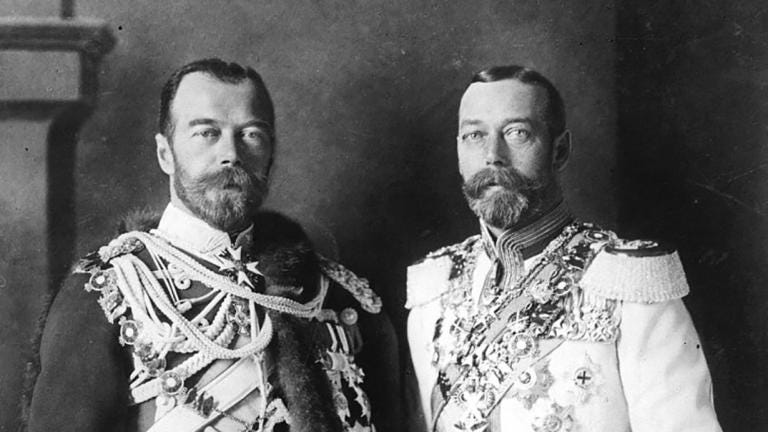
About ten years ago, we were enthralled by a BBC documentary titled Royal Cousins at War, which examined the deep ties and conflicts among three European royal first cousins and how those relationships shaped history before and during World War I. The subject was undeniably grim. In many respects, the First World War amounted to a family feud that cost millions of lives.
If there was any levity to be found, it came from the doppelgänger cousins themselves. Britain’s King George V (”Georgie”) and Russia’s Tsar Nicholas II (”Nicky”) were first cousins, connected through their mothers, Alexandra of Denmark (Queen Alexandra). and Dagmar of Denmark (Empress Maria Feodorovna)., who were sisters. Georgie and Nicky resembled each other so closely that it’s said they sometimes pranked friends, family members, and even government ministers by swapping uniforms.
The photographs didn’t lie.
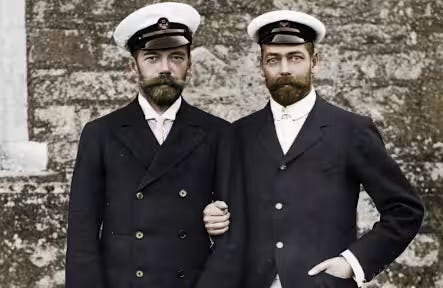
“Patrick,” I said, “those first cousins look like twins. Identical twins!”
That was all the cue Patrick needed. He began singing in that mock-plaintive voice of his, the one he knows will eventually crack my I am not amused composure and make me laugh out loud.
“But they’re cousins, Identical cousins, and you’ll find …”
I immediately recognized the theme from an old 1960s television show about identical cousins: The Patty Duke Show.
But Patrick only escalated, now singing with exaggerated conviction:
“They laugh alike, they walk alike, At times they even talk alike …”
When you’ve been married as long as we have, you develop an instinct for how far the other can go before laughter becomes inevitable. And the way Patrick sang, leaning fully into that imploring tone of his, sealed it:
“… You can lose your mind When cousins are two of a kind!”
By then, I was laughing so hard my stomach hurt.
A few years later, DNA analysis brought actual cousins into Patrick’s life. They lived relatively close to us. Patrick was adopted as a toddler, so he didn’t grow up knowing any close blood relatives. When he did eventually find them, they were few and widely scattered across the globe.
That’s why we were especially moved to learn more about Patrick’s history and about his biological mother’s family, through whom he was related to these newly discovered Irish cousins. We were warmly welcomed into the Northwest home of one cousin and her husband, who invited us to stay overnight during several holidays. Finding these blood relatives meant a great deal to Patrick.
Another cousin, Michael, lived a bit farther away in San Francisco. In November 2024, we flew down and met him over several shared meals. Not long ago, Michael texted us: “I knew the moment I met you: you’re my people.”
Although Patrick and I aren’t religious ourselves, during the holidays last year we sent the cousins a couple of cards. The message we received back from Michael, who sends a faith-based Christmas letter each year to his closest family members, was so generous and unexpected that I wanted to write about it. Michael gave me permission to quote him.
Knowing that we’re not believers, Michael explained that he had hesitated before sending us his religiously themed family Christmas greeting, along with his letter of “personal spirituality.” In the end, he said, two considerations guided his decision.
Beneath a medieval-style illustration of the Nativity, the letter began simply: Dear Family. On the back, Michael had added a personal message addressed to Patrick and me:
“Firstly, our differences in faith have always, since our first encounter, been overshadowed by our kindred respect for those differences.
Secondly, this letter accompanies only the cards I send to family. Faith-based or not, you are both family to me, and the thought of excluding you from a family communiqué becomes unthinkable in that light.
We’ve been family since the moment of our birth (think of how many years that was before we actually met), and we’ll remain family long after our time on Earth has passed. Your kinship and friendship are treasures that far outweigh anything I could find in a stocking or under a tree this year. Thank you, each and both, for filling my heart with gratitude!
Happy Hannukwaanzmass!”
Patrick and Michael are Facebook friends. When Michael later posted what appeared to be an AI-generated Nativity scene, Patrick responded in characteristic form: “In the spirit of the season, please accept this art, which I appreciated as a movie fan but which also made me think of some of your recent inspired creations.”:
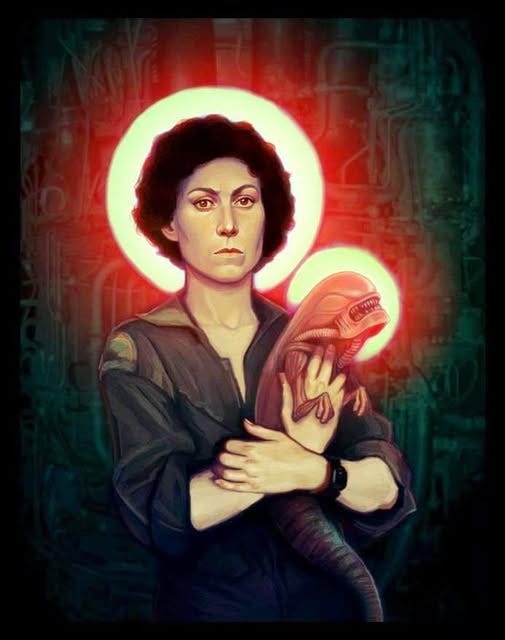
Secure in his faith and in himself, Michael wasn’t offended. Instead, he rolled with it, replying with a playful acknowledgment of his fondness for the movie Alien. Michael, of Irish and Italian heritage, and Patrick, of Irish and African heritage, often meet at this crossroads: finding humor in hardship and life’s absurdities through wit that reflects both kindness and resilience.
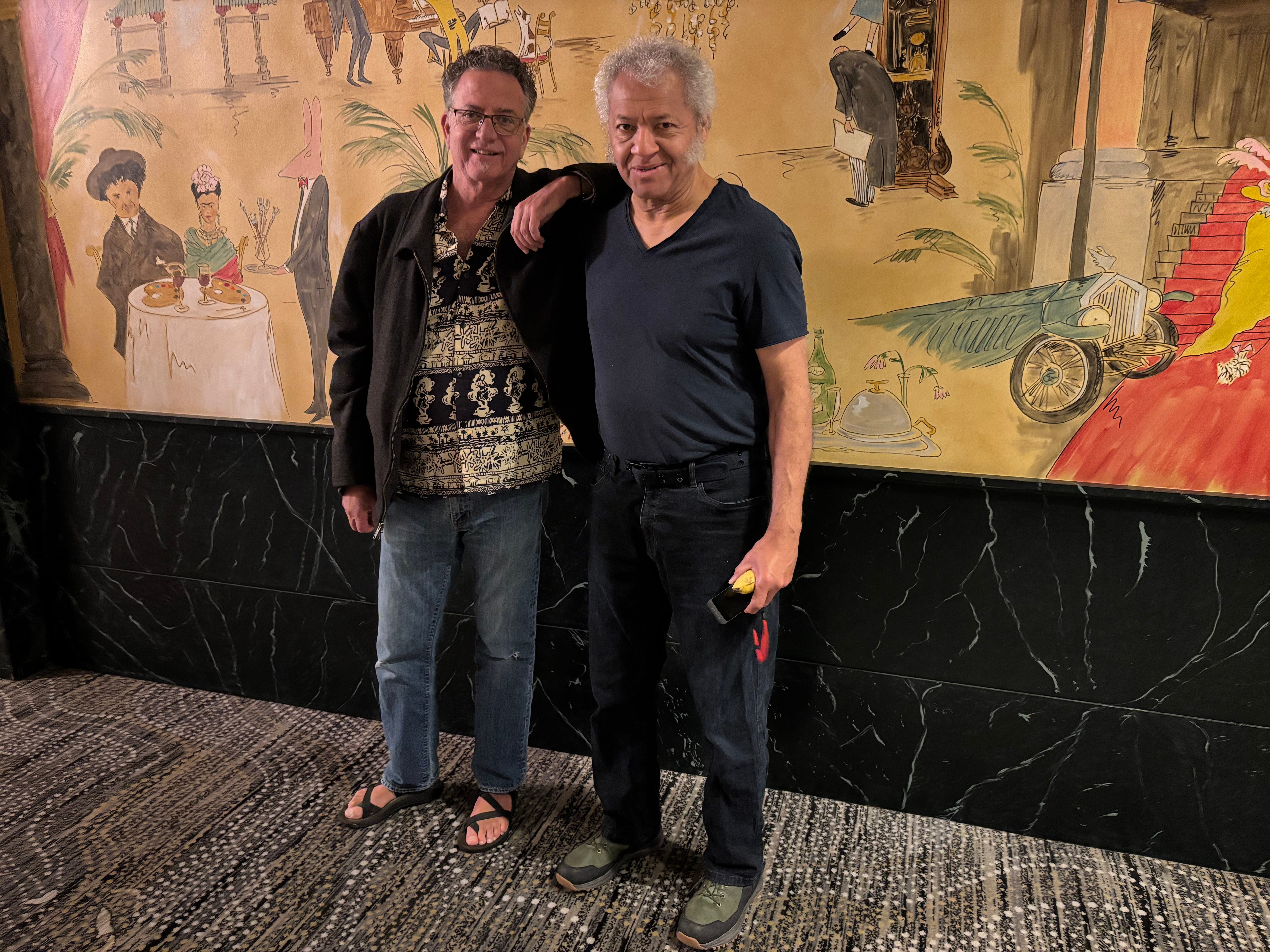
Reading Michael’s words, I was struck by how naturally the language of kinship expands when it is rooted in generosity rather than doctrine. Here, family wasn’t a boundary to be defended but an invitation extended. What bound them wasn’t belief, but recognition: shared regard, shared history, shared humanity.
It’s often said that if we go back far enough, we are all cousins. Biologically, this is true. Human family trees don’t branch endlessly outward; they loop back in on themselves. Migration, marriage, conquest, and survival have braided us together so thoroughly that separation is more imagined than real. The distinctions we elevate (race, religion, nation, creed) are comparatively recent overlays on an ancient common ancestry.
Still, this idea can be misused. Saying we are all cousins does not absolve us of reckoning with history. Shared ancestry does not erase injustice or diminish harm. It must never be used to smooth over inequality, to quiet rightful grievance, or to imply that cruelty somehow weighs less because it occurs within the family.
If anything, kinship should sharpen the moral edge.
The genetic differences we fixate on are vanishingly small compared to what we share. Yet the meanings we attach to those differences through violence, race, hierarchy, religion, and ideology carry immense and often devastating force.
Human division is socially loud but biologically shallow.
Michael and Patrick may not look alike, speak alike, or believe alike, but like cousins separated by time and circumstance, they remain unmistakably of the same family.
If we Homo sapiens are indeed all cousins, then exclusion and dehumanization are not abstractions. They are acts committed against our extended family, often in service of myths far younger than our shared origins. Kinship does not excuse harm; it intensifies the betrayal.
“We must learn to live together as brothers or we will perish together as fools.” – Dr. Martin Luther King Jr.
It's so great that the now common American racism of the leadership and the approval of being outright racist was overcome by the cousins, but then in Europe we have lived with that experience for more than eighty years and had to find a way to reconcile with the past. The USA is still in its baby shoes.
What a lovely story about finding oneself in others. I so enjoyed the pics, historical and of the guys..